
Bitunix Review 2026: Futures Trading Fees, Funding and Risk Controls
Affiliate Disclosure:
GNCrypto editors review services independently. If you click on affiliate links, we may earn commissions, which help support our testing. The goal of our reviews is to provide our readers with the most objective and unbiased overviews of available platforms for spot crypto trading.
Bitunix Futures

Bitunix is a solid futures platform if you want a modern perpetuals interface, clear fee tiers, and practical risk guardrails like mark price logic. Just track 8-hour funding and avoid holding oversized positions into maintenance windows.
GNcrypto's Verdict

Bitunix is a centralized crypto exchange built around USDT-margined perpetual futures. In our testing, the platform feels geared toward active retail traders: clear VIP fee tiers, a standard 8-hour funding rhythm, and risk mechanics that lean on index and mark price logic. Bitunix also offers a multi-asset collateral mode for advanced users, plus practical TP and SL workflows for beginners who want structure.
- Competitive futures fees
- Mark price risk guardrails
- Broad perp market menu
- Funding adds carry cost
- Maintenance windows matter
On this page

Fees & Funding
4.5/5
Leverage & Margin
4.5/5

Fees & Funding
4.2/5
Leverage & Margin
4.2/5

Fees & Funding
4.2/5
Leverage & Margin
4.3/5

Fees & Funding
4.4/5
Leverage & Margin
4.2/5

Fees & Funding
4.5/5
Leverage & Margin
4/5
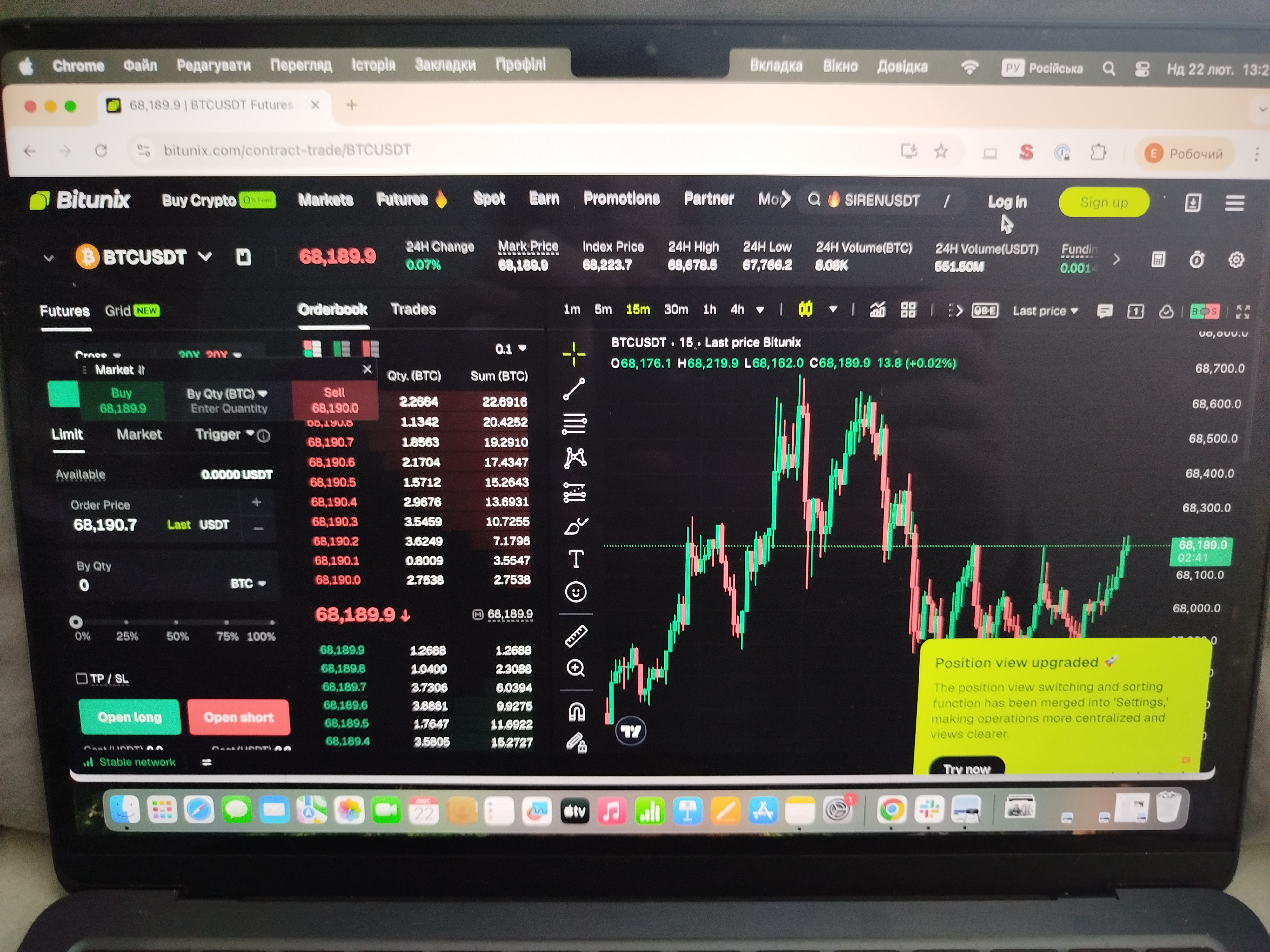
GNcrypto reviews Bitunix as a futures-first exchange for USDT margined perpetuals. We focus on real fees, 8-hour funding, margin modes, and risk guardrails like mark price and price protection, then map who it fits best and what to watch before trading live.
What Bitunix Is
Bitunix positions itself as a futures-first exchange built around USDT-margined perpetual contracts. That focus shows up in a straightforward long/short workflow where you do not have to think about expiry dates or rolling contracts. That matters for beginners because you are trading the typical long and short workflow without worrying about expiry dates or rolling contracts. You open a position, manage risk, and close it when your plan says so.
In day-to-day use, Bitunix feels easiest to understand if you focus on three things you will touch on your very first trade. First, you choose a margin mode. The platform supports both cross margin (shared collateral) and isolated margin (risk contained to one position). We think isolated is the calmer starting point while you are still learning sizing and stops.
Second, Bitunix gives you the basic safety tools you actually need to survive your first week. Take-profit and stop-loss orders are part of the core flow, and in our experience that is where beginners should spend their attention before chasing higher leverage or exotic strategies.
Third, Bitunix leans on index price and mark price concepts to reduce wick-driven chaos. The key idea is simple: liquidation and PnL logic should reference a fairer price than a single last trade print. You do not need to memorize formulas to benefit from this, but it is useful to know why your interface may show more than one price.
Finally, Bitunix is not a “two-coin” venue. It offers hundreds of perpetual pairs, and it also supports a multi-asset collateral mode as an option for traders who want to post more than just USDT. We will break down what that means for costs and limits in the next section of our Bitunix reviews.
Fees, Limits and Cost Structure
Costs are where most futures platforms either feel transparent or quietly expensive. For this Bitunix exchange review, we looked at the cost stack the way a beginner actually feels it: trading fees on every entry and exit, funding that accrues while you hold, withdrawal costs when you cash out, and the account limits that can surprise you later.
Trading fees. Bitunix publishes a clear VIP schedule for futures. At the base tier, the futures fee is 0.02% maker / 0.06% taker, and higher VIP tiers reduce those rates (down to single‑digit basis points on maker and lower taker as you scale). The practical takeaway is simple: if you are learning, try to enter with limit orders when you can, and treat taker fills as the “price of urgency.”
Funding. Futures funding is the cost most beginners underestimate. Bitunix uses the standard 8‑hour funding cadence at 00:00, 08:00, and 16:00 UTC, and it notes that some pairs can have schedule adjustments in specific market conditions. Our mental math is: 24 hours = 3 funding windows, 3 days = 9, 7 days = 21. If you plan to hold for days, funding can matter more than the headline maker fee.
Deposits and withdrawals. Bitunix states deposits are free, while withdrawals depend on the asset and network. In practice, that means you should check the withdrawal page before you commit to a network: BTC has a network-based fee and minimum, and USDT costs vary materially by chain.
Limits and KYC tiers. Bitunix publishes a tiered withdrawal structure: up to 500,000 USDT without verification, 3,000,000 USDT with basic KYC, and 5,000,000 USDT with advanced KYC. For small accounts, KYC is often less about trading access and more about keeping withdrawals smooth.
Multi‑assets mode. Using multiple collateral assets can be convenient, but it also adds moving parts. If your account creates a negative USDT balance, Bitunix’s rules allow auto‑conversion based on its exchange rate and threshold logic. We would start in single‑asset USDT mode first, then upgrade to multi‑asset once you understand how those conversions work.
Who Bitunix Is Best For
So who is Bitunix actually a good fit for? In our Bitunix review, Bitunix makes the most sense for futures traders who want a fairly modern perp venue with clear “engine rules” and enough market variety to grow beyond BTC and ETH.
If you are a beginner building habits, we think Bitunix can work well as long as you treat leverage as a tool, not a game. Our rule of thumb is to start in the 3x–10x range, use isolated margin while you are learning, and make TP/SL part of every trade plan.
If you care about guardrails in the liquidation system, Bitunix is worth a look. In our experience, platforms that emphasize index and mark price logic feel more predictable during fast wicks, because your position is less likely to be judged by a single noisy print.
If you want to explore alt perpetuals, Bitunix’s contract menu is broad enough to keep you busy. The way we would approach it is “majors first, then long tail,” and once you move beyond the top pairs, prefer limit entries so you control slippage.
If you trade during major events, plan around operations. Bitunix has communicated that during some maintenance windows, futures trading can be unavailable and TP/SL triggers may not fire. We do not treat that as a deal breaker, but we would reduce risk or flatten positions before scheduled upgrades.
Pros and Cons of Using Bitunix Futures
This section is about what you will actually notice in day-to-day leveraged trading: how predictable entries feel, how easy it is to protect a position with basic orders, and where the platform’s rules can surprise you if you hold through funding windows or maintenance.
Strengths:
- Market price protection: If you have ever fat-fingered a limit price or chased a move with a market order, Bitunix’s price bounds can help prevent extreme fills in thin moments.
- Safer openings for beginners: Bitunix has shipped product updates that add checks designed to reduce accidental “too-close-to-liquidation” entries when you open a position.
- Multi-assets collateral option: If you hold BTC or ETH long term and want to hedge on perps without constantly converting to USDT, multi-asset collateral can be convenient.
- TP/SL learning curve is manageable: The platform has step-by-step guidance for setting and modifying take-profit and stop-loss, which is where most beginners win or lose.
Weaknesses:
- Maintenance risk is real: Bitunix has stated that during some system upgrades, futures trading can be unavailable and TP/SL triggers may not fire, so we would avoid holding oversized risk into scheduled maintenance.
- Funding is not always “strictly 8-hour” on every pair: The standard schedule can be adjusted for specific contracts in certain market conditions, so longer holds deserve a quick check.
- Multi-assets adds complexity: Auto-conversion rules can kick in if your account creates a negative USDT balance, which is powerful but not beginner-proof.
Trustworthiness Сheck
Here are the trust and compliance signals we found while researching Bitunix.
- Proof of Reserves: Bitunix publishes PoR materials and provides a public GitHub repo to support Merkle-based verification.
- Account security you can enable on day one: Anti-phishing code and passkey guidance are documented in the Help Center.
- Compliance signal in Australia: Bitunix has communicated an AUSTRAC registration milestone, while also noting that registration is not the same as endorsement.
- Jurisdiction check reminder: Securities Commission Malaysia has listed Bitunix on its Investor Alert List for unauthorised entities (always confirm availability and legality in your country).
- Security process maturity: Bitunix has published updates around its bug bounty program, which is a positive signal that vulnerability reporting is formalized.
GNcrypto’s Overall Bitunix Futures Rating
| Criteria | Rating (out of 5) |
|---|---|
| Trading Fees & Funding Costs | 4.2 |
| Leverage & Margin Requirements | 4.3 |
| Contract Selection & Liquidity | 4.0 |
| Platform Performance & Risk Controls | 4.1 |
| Security & Regulatory Compliance | 4.2 |
| User Experience & Trading Interface | 4.0 |
| Customer Support & Educational Resources | 4.0 |
| Total | 4.2 / 5.0 |
Methodology – Why You Should Trust Us
We use a weighted, category-based model, collect standardized data from each platform (open data + hands-on testing), and convert that into a 1.0–5.0 star score in 0.1 increments.
Our focus is futures trading quality: real fees + funding costs, leverage flexibility, market depth, execution speed during volatility, and the user-facing risk controls.
How We Collect Data
- Public data: fee schedules (maker/taker/VIP), funding rate history, margin tiers, and regulatory status.
- First-hand testing: we place test trades, open leveraged positions (10x–50x), measure spreads and slippage during market moves, and verify stop-loss execution.
We do not rate solvency or make guarantees about financial stability. Ratings reflect the trader’s experience, not a balance-sheet audit.
Categories & Weights
- Trading Fees & Funding Costs – 25%
- Leverage & Margin Requirements – 20%
- Contract Selection & Liquidity – 15%
- Platform Performance & Risk Controls – 15%
- Security & Regulatory Compliance – 10%
- User Experience & Trading Interface – 10%
- Customer Support & Educational Resources – 5%
Latest News





Recommended Articles/Reviews



The material on GNcrypto is intended solely for informational use and must not be regarded as financial advice. We make every effort to keep the content accurate and current, but we cannot warrant its precision, completeness, or reliability. GNcrypto does not take responsibility for any mistakes, omissions, or financial losses resulting from reliance on this information. Any actions you take based on this content are done at your own risk. Always conduct independent research and seek guidance from a qualified specialist. For further details, please review our Terms, Privacy Policy and Disclaimers.