
AscendEX Review: Futures Fees, Leverage Options, and Trading Experience for Active Crypto Traders
Affiliate Disclosure:
GNCrypto editors review services independently. If you click on affiliate links, we may earn commissions, which help support our testing. The goal of our reviews is to provide our readers with the most objective and unbiased overviews of available platforms for spot crypto trading.
AscendEX

AscendEX is a solid option for derivatives trading if you want competitive maker-taker fees, up to 100x leverage on major pairs, and a platform that combines order-book futures with staking and yield products in one account.
GNcrypto’s Verdict

AscendEX is a centralized exchange focused on derivatives and users outside the U.S. Its core offering is perpetual futures with up to 100x leverage, cross and isolated margin, and risk management through margin tiers and auto-liquidations.
- Low base futures fees: from 0.02% taker and 0.00% maker for USDT-margined contracts at the standard tier.
- Up to 100x leverage on major pairs (BTC, ETH), with convenient cross and isolated margin in one interface.
- A flexible tier system with discounts for ASD holders and high trading volumes.
- Not available to residents of the U.S. and certain other jurisdictions.
- Thin liquidity on altcoins: we measured 0.87% slippage on a SOL/USDT market order, with only $8k depth within 0.5% of mid. BTC/ETH liquidity is adequate, but avoids market orders on low-cap pairs.
On this page

Fees & Funding
4.5/5
Leverage & Margin
4.5/5

Fees & Funding
4.2/5
Leverage & Margin
4.2/5

Fees & Funding
4.2/5
Leverage & Margin
4.3/5

Fees & Funding
4.4/5
Leverage & Margin
4.2/5

Fees & Funding
4.5/5
Leverage & Margin
4/5
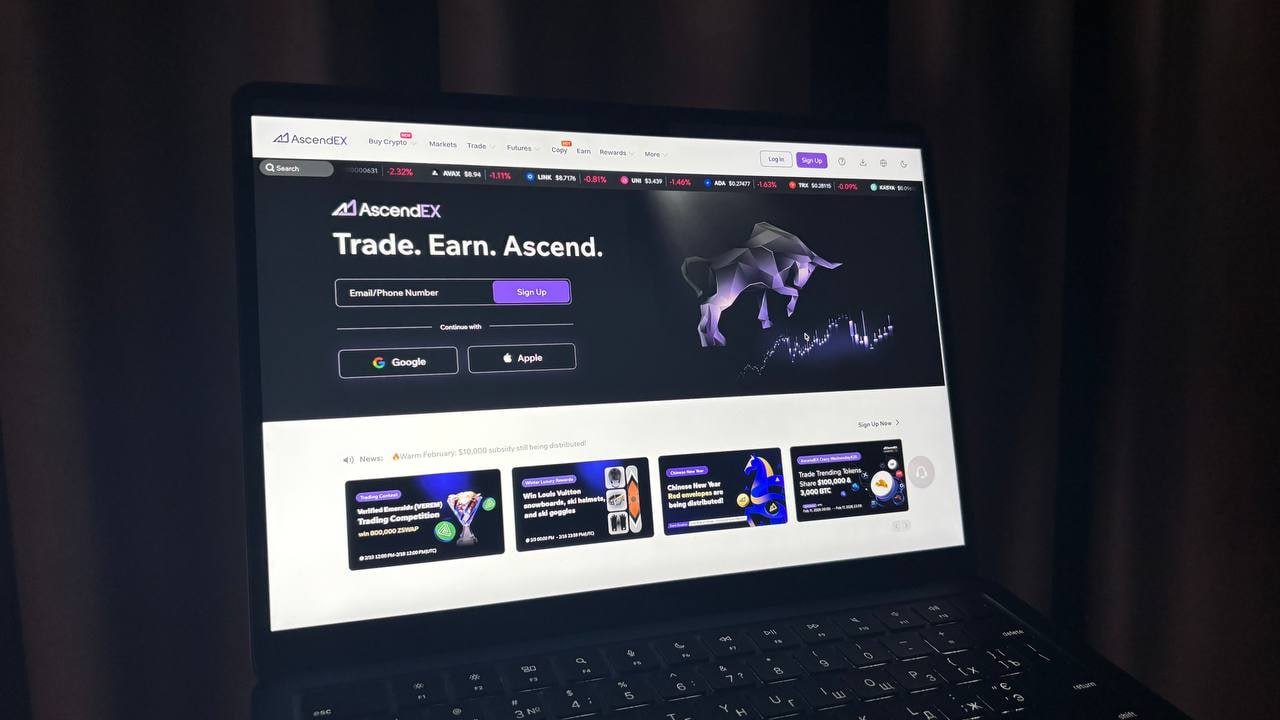
AscendEX is a derivatives-focused crypto platform that targets active futures traders with high leverage, deep liquidity on majors, and frequent promotions. In this article, we look at how its fees, risk tools, and trading interface perform in real conditions, from opening an account to closing leveraged positions.
For this AscendEX review, we created a separate account, completed verification, and funded it with 200 USDT. We focused on futures trading, so we tested perpetual contracts on BTC/USDT, ETH/USDT, and several liquid altcoins.
We opened and closed positions at different sizes – from small test lots to trades comparable to real execution – tested cross and isolated margin, market and limit orders, and partial and full position closes.
Test Results
BTC/USDT perpetual (low-cost execution):
- Position size: $250 notional (2.5x leverage, $100 margin)
- Entry: limit order, filled as maker → $0.10 fee (0.02%)
- Hold: 18 hours, 2 funding cycles → -$0.04 funding paid
- Exit: limit order → $0.30 taker fee (0.06%)
- Total cost: $0.44 on $250 position (0.09%)
SOL/USDT perpetual (slippage test):
- Position size: $600 notional (6x leverage)
- Entry: market order at 10:15 UTC
- Slippage: 0.87% (order book depth: only $8k within 0.5% of mid)
- Observation: thin liquidity on altcoins makes large market orders expensive
Withdrawal test:
- Initiated: 200 USDT to external wallet
- Processing time: 25 minutes
- Network fee: 1 USDT (TRC-20)
- No issues, funds arrived as expected
Friction points:
- KYC verification took 45 minutes (passport + selfie required)
- Funding rate display shows 8h rate, not annualized – beginners may misread costs
- Interface cluttered with staking/earn tabs unrelated to futures trading
What is AscendEX?
AscendEX is a centralized crypto exchange focused on active trading and derivatives. Under the AscendEX exchange brand, the platform offers linear perpetual futures quoted and settled in USDT: BTCUSDT, ETHUSDT, and a range of popular altcoins.
These contracts support cross and isolated margin, hedged and one-way position modes, and a standard order set: limit, market, conditional, trailing stop, and “reduce only.” Maximum leverage is listed at up to 200x, but the actual available level depends on the pair and position size.
How AscendEX Futures Trading Works
AscendEX’s futures trading terminal will feel familiar to anyone who has traded derivatives: the order book, trade tape, market depth, order ticket, and a risk-management panel with cross and isolated margin. The exchange offers perpetual contracts on BTC, ETH, and dozens of altcoins with leverage up to 100x, and new listings (for example, POLUSDT) may launch in a protected mode with post-only orders.
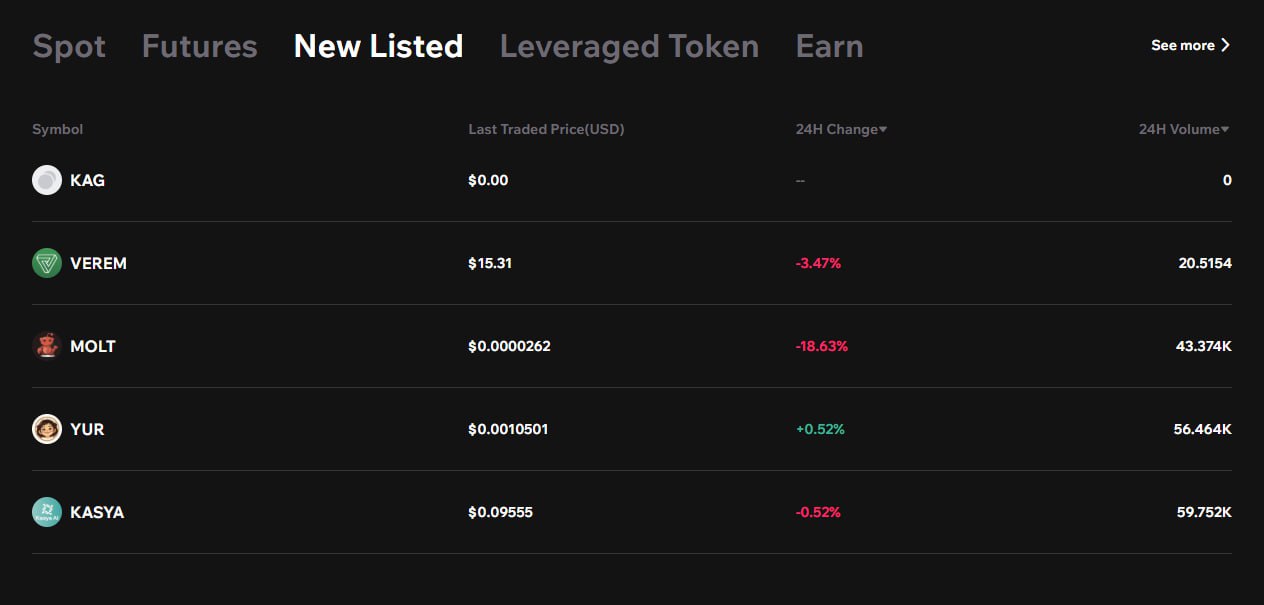
The order form supports market, limit, stop, and take-profit orders, plus position-reduction and forced-close modes. AscendEX futures fees follow a tiered VIP schedule: base rates are higher, but drop materially as volume increases and with ASD token staking.
Liquidity on major pairs (BTC/USDT, ETH/USDT, and large L1s) is sufficient for orders in the tens of thousands of dollars without noticeable slippage, but niche altcoins show wider spreads and thinner depth. That matters: in this AscendEX exchange review, we saw 0.87% slippage when opening a $600 SOL/USDT market order (6x leverage), with only $8k depth within 0.5% of mid. Larger orders would face even worse execution.
Conclusions
The takeaway from this AscendEX review is straightforward: the exchange works as a secondary derivatives venue for BTC and ETH futures at mid-size volumes.
Pros: competitive fees (0.02%/0.06%), clean terminal, full order set, flexible margin.
Cons: thin altcoin depth (0.87% slippage on SOL), cluttered interface, 2021 hack history lowers trust. It’s not a primary venue, but it’s functional if you don’t need top-3 liquidity.
Pros, Cons & Limitations
How AscendEX behaves in daily use:
Strengths:
- Low futures fees: base rates around 0.02% maker and 0.06% taker. In our test, a $250 BTC perpetual cost $0.44 total (0.09% round-trip), cheaper than exchanges charging 0.05%/0.10%.
- The exchange’s daily derivatives volume on BTC/USDT and ETH/USDT runs in the hundreds of millions of dollars.
- Isolated and cross margin are available, with tiered leverage increases (up to 100x on major pairs) and a partial liquidation mechanism.
Weaknesses:
- In December 2021, AscendEX lost about $77 million from hot wallets in a hack.
- The platform is unavailable or restricted for users in certain jurisdictions, including the U.S.
- Limited derivatives selection.
- The futures terminal interface is cluttered with tabs (Earn, DeFi products, staking)./yab
Given its past hack, country restrictions, and a not-so-broad contract lineup, we think experienced traders should treat the platform as a secondary venue rather than their only access point for derivatives.
Trustworthiness Check
Most AscendEX user funds are held in cold wallets, while hot wallets are used only for operational liquidity. The exchange cites a “defense-in-depth” approach, multi-factor authentication (Google 2FA for login and withdrawals), data encryption, and continuous monitoring for suspicious activity.
The platform also emphasizes strict KYC/AML procedures and an insurance fund intended to cover potential client losses.
AscendEX suffered a hot-wallet hack in December 2021 for about $77 million in tokens on Ethereum, BNB Chain, and Polygon. The team immediately paused deposits and withdrawals, said cold wallets were not affected, and promised to fully reimburse users from its own reserves. However, no independent audit of the reimbursement was published, and the incident remains a trust liability. The exchange later reported migrating its infrastructure and regenerating deposit addresses to strengthen security.
Based on our research, AscendEX is a Singapore-based platform operating in 150+ jurisdictions, but it does not hold licenses from major financial regulators; access for U.S. residents and users in several other countries is restricted. It also lacks public proof-of-reserves reports: AscendEX does not appear on exchange lists that publish open Merkle-based reserve audits.
GNcrypto’s AscendEX Overall Rating
| Criteria | Rating (out of 5) | Weight | Notes |
|---|---|---|---|
| Trading Fees & Funding Costs | 3.5 / 5 | 25% | Perpetual futures fees run around 0.04% maker / 0.06% taker for the standard tier; funding is charged every 8 hours, with discounts for high-volume and ASD-staking users. |
| Leverage & Margin Requirements | 4.0 / 5 | 20% | Up to 100–200x leverage on major contracts with isolated and cross margin; portfolio-style margin is available for professional accounts, but liquidation risk rises quickly at high leverage. |
| Contract Selection & Liquidity | 3.0 / 5 | 15% | Dozens of USDT-margined perpetuals; liquidity is solid on BTC/ETH but noticeably thinner on small-cap pairs compared to top-tier futures venues. |
| Platform Performance & Risk Controls | 3.5 / 5 | 15% | A stable matching engine with standard order types (limit, market, stop); risk controls include auto-deleveraging and maintenance margin, but advanced risk-management tools are limited. |
| Security & Regulatory Compliance | 3.0 / 5 | 10% | Centralized custodial model; the exchange suffered a hot-wallet hack in December 2021 (≈$77M), said it fully covered user losses, but the incident lowers overall trust. |
| User Experience & Trading Interface | 3.5 / 5 | 10% | Web terminal and mobile apps with a familiar derivatives interface, built-in depth chart, and a risk-metrics panel, but navigation feels cluttered with products and staking campaigns. |
| Customer Support & Educational Resources | 2.5 / 5 | 5% | Support via tickets and Telegram; there is a knowledge base, but trader complaints about slow responses and disputed charges (e.g., unclear fees and an inactivity fee) are fairly common. |
Final Score: 3.4 / 5
Methodology – Why You Should Trust Us
We evaluated AscendEX with our weighted, category-based framework, depositing $200 in BTC and opening leveraged positions on BTC/USDT and ETH/USDT perpetuals. During our test we tracked funding rates, checked stop-loss execution, measured slippage on different order sizes, and tested both isolated and cross margin modes. Platforms are scored from 1.0 to 5.0 across seven weighted criteria, using real money rather than demo accounts.
Read our full methodology: How We Test Crypto Futures Trading Services
Latest News




Recommended Articles/Reviews



The material on GNcrypto is intended solely for informational use and must not be regarded as financial advice. We make every effort to keep the content accurate and current, but we cannot warrant its precision, completeness, or reliability. GNcrypto does not take responsibility for any mistakes, omissions, or financial losses resulting from reliance on this information. Any actions you take based on this content are done at your own risk. Always conduct independent research and seek guidance from a qualified specialist. For further details, please review our Terms, Privacy Policy and Disclaimers.