15% of Ukrainian IT specialists consider investing in crypto

Where do Ukrainian developers put their money and what is the state of the IT market in 2025? DOU analysts released a comprehensive survey showing how the tech community is maturing and evolving.
The DOU study surveyed over 13,000 IT specialists, most of whom hold technical positions. However, the number of non-technical specialists (HR, recruiters, project and product managers, marketing specialists, business analysts) is gradually growing in the labor market. Their share, which was about 9% in previous years, has now increased to 12%.
More than a third of the respondents stated that they invest part of their income to preserve its value. Almost half of specialists (41%) regularly donate to support the Armed Forces of Ukraine, 35% invest in their health, sports, and psychotherapy, and 28% allocate money for education and professional development.
At the same time, only one in three technical specialists uses more complex financial instruments. Around 30% invest in securities such as stocks and bonds, 15% are interested in cryptocurrency, 10% put money into developing their own businesses, and 9% see real estate as a promising investment.
A quarter of the respondents said they have not yet chosen an investment option, and roughly the same number admitted that their income does not allow them to invest at all.
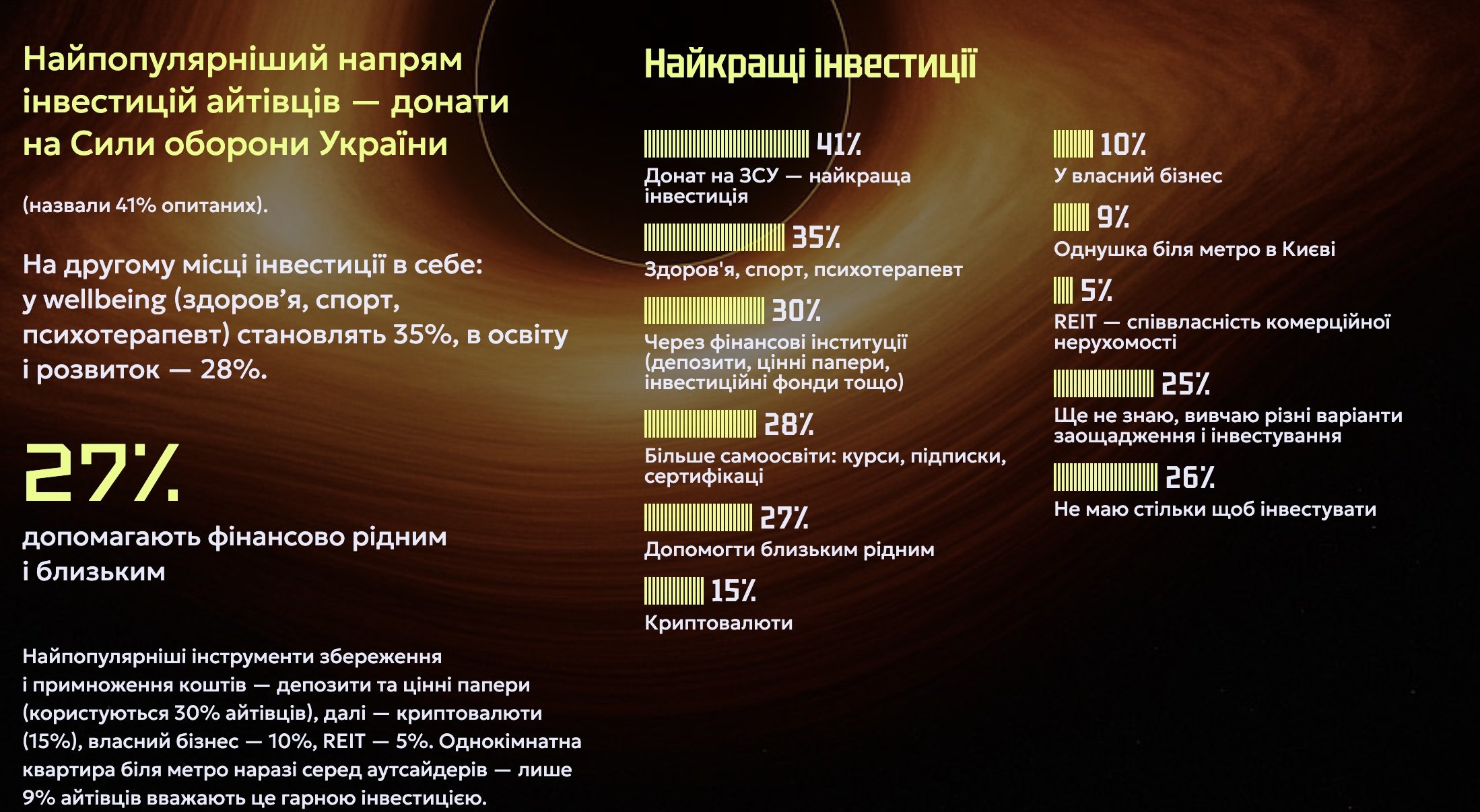
Main investment directions of Ukrainian IT specialists. Source: DOU
The study showed that the industry’s structure is undergoing noticeable change. The share of junior developers and testers is gradually decreasing, while the number of experienced professionals with more than ten years in the field is growing. Currently, they account for 27%, compared to just 24% a year ago.
Another clear trend is the widespread shift to remote work. Almost 70% of respondents work from home or from co-working spaces, and 26% go to the office only occasionally. This model of employment is especially common in startups and small companies, which makes sense given that 57% of respondents are registered as private entrepreneurs (FOPs), only 9% are formally employed on company staff, and 5% work “off the books.”
At the same time, the workload has noticeably increased over the past year. While only 15% of respondents worked more than 45 hours a week a year ago, now this figure has increased to 23%. But only two-thirds of them receive compensation for the extra hours.
According to the survey, the average salary in IT is $3,000, which is slightly higher than a year ago ($2,900). The highest earners remain the most experienced: among specialists over 43, average income is approaching $4,500. However, 11% of participants admitted that they spend more than they earn and use credit. This figure has increased compared to last year.
Against the backdrop of these changes, stress levels are also increasing. Respondents noted concerns about an uncertain future, ongoing mobilization and shelling, and the possible loss of their jobs.
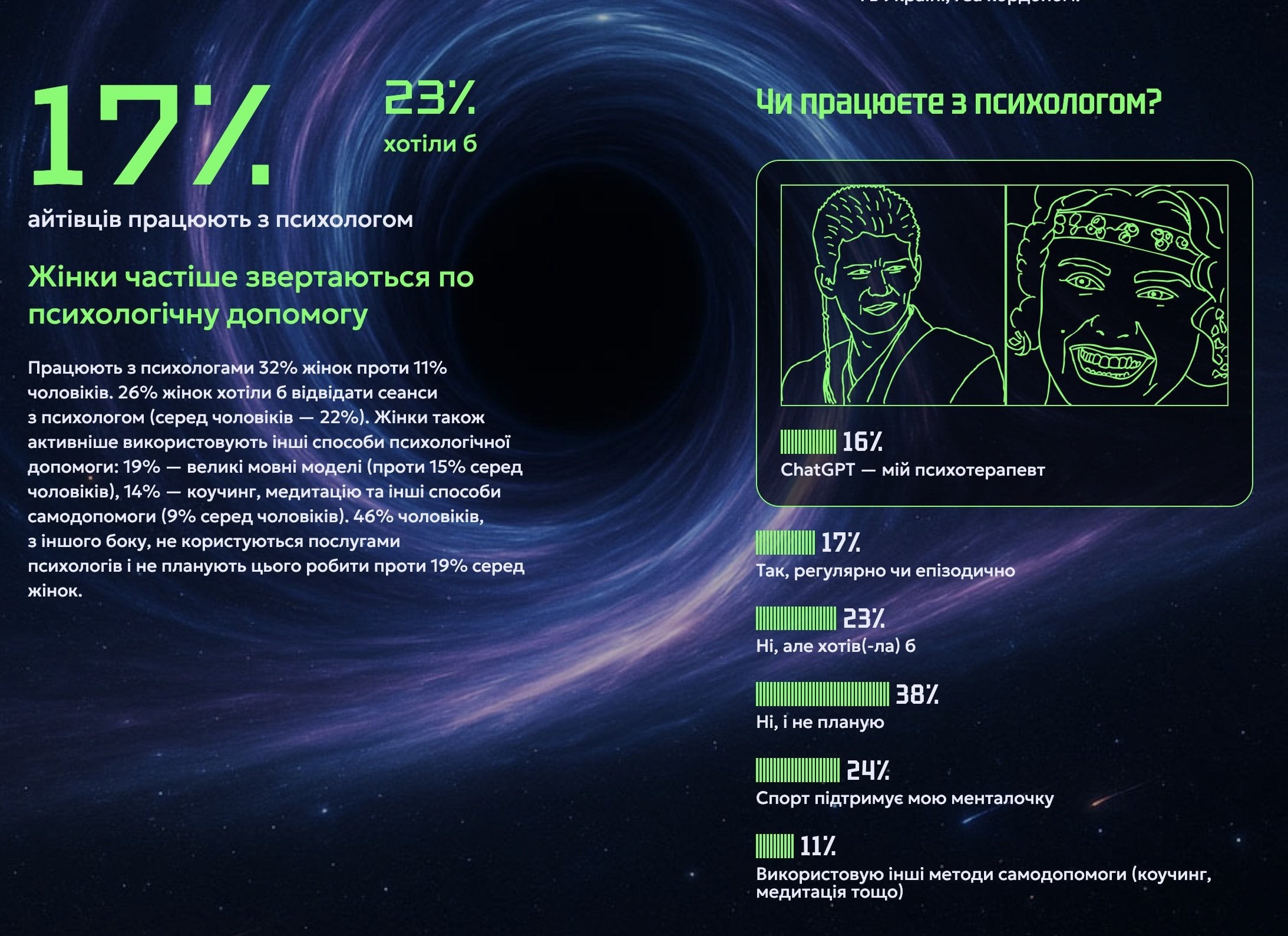
Only one in six IT specialists consults a psychotherapist. Source: DOU
On the one hand, Ukraine’s IT sector is becoming older and more experienced: new roles and interesting vacancies are appearing, salaries are growing, albeit slowly, and remote work is becoming the standard. On the other hand, the pressure is also mounting: the workload is increasing, the level of anxiety is rising, and more specialists under 25 are considering emigration (48% compared to 14% planning to stay in the country).


Recommended