U.S. Congress pushes Treasury to detail Bitcoin reserve strategy

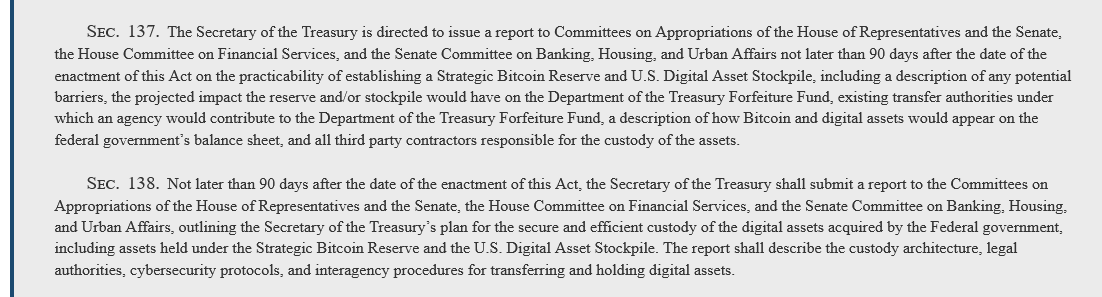
U.S. lawmakers are moving closer to formalizing the country’s first strategic Bitcoin reserve, demanding a Treasury Department report that would clarify how digital assets are held, secured and reported on the federal balance sheet.
The directive, introduced in an appropriations bill by Representative David P. Joyce, follows President Donald Trump’s March executive order that called for the creation of a Strategic Bitcoin Reserve and a broader federal stockpile of digital assets. If enacted, the bill would give Treasury 90 days to deliver a comprehensive plan covering custody arrangements, interagency transfers, cybersecurity measures and potential third-party contractors.
Treasury Secretary Scott Bessent has said the department is exploring “budget-neutral pathways” to expand the reserve, using existing seizures to seed the fund. Lawmakers also want the report to assess how such a reserve might affect the Treasury Forfeiture Fund, which currently channels proceeds from confiscated assets into law enforcement.
Joyce framed the effort as both a modernization push and a national security measure. “This legislation ensures the federal government is fiscally responsible, leverages new technology, and is focused on national security,” he wrote in a recent post on X.
Bitcoin strategies, once considered radical, are increasingly part of mainstream policy debates. Other nations are exploring similar paths: Kazakhstan’s President Kassym-Jomart Tokayev recently outlined plans for a state digital asset fund, while lawmakers in the Philippines are weighing a proposal to build a 10,000-Bitcoin reserve. El Salvador expands its Bitcoin reserves, which now exceeds 6,300 BTC.
Globally, sovereign entities already hold more than 517,000 BTC - about 2.5% of total supply - according to Bitbo. Analysts say the trend could eventually tighten liquidity and reinforce Bitcoin’s role as a reserve-style asset, drawing closer parallels to gold in government portfolios.
Treasury Secretary Scott Bessent has said the department is exploring “budget-neutral pathways” to expand the reserve, using existing seizures to seed the fund. Lawmakers also want the report to assess how such a reserve might affect the Treasury Forfeiture Fund, which currently channels proceeds from confiscated assets into law enforcement.
Joyce framed the effort as both a modernization push and a national security measure. “This legislation ensures the federal government is fiscally responsible, leverages new technology, and is focused on national security,” he wrote in a recent post on X.
Bitcoin strategies, once considered radical, are increasingly part of mainstream policy debates. Other nations are exploring similar paths: Kazakhstan’s President Kassym-Jomart Tokayev recently outlined plans for a state digital asset fund, while lawmakers in the Philippines are weighing a proposal to build a 10,000-Bitcoin reserve. El Salvador expands its Bitcoin reserves, which now exceeds 6,300 BTC.
Globally, sovereign entities already hold more than 517,000 BTC - about 2.5% of total supply - according to Bitbo. Analysts say the trend could eventually tighten liquidity and reinforce Bitcoin’s role as a reserve-style asset, drawing closer parallels to gold in government portfolios.


Recommended