Polkadot holders vote on launching algorithmic stablecoin

The Polkadot community is debating the launch of a native algorithmic stablecoin, pUSD, which would be fully backed by DOT tokens.
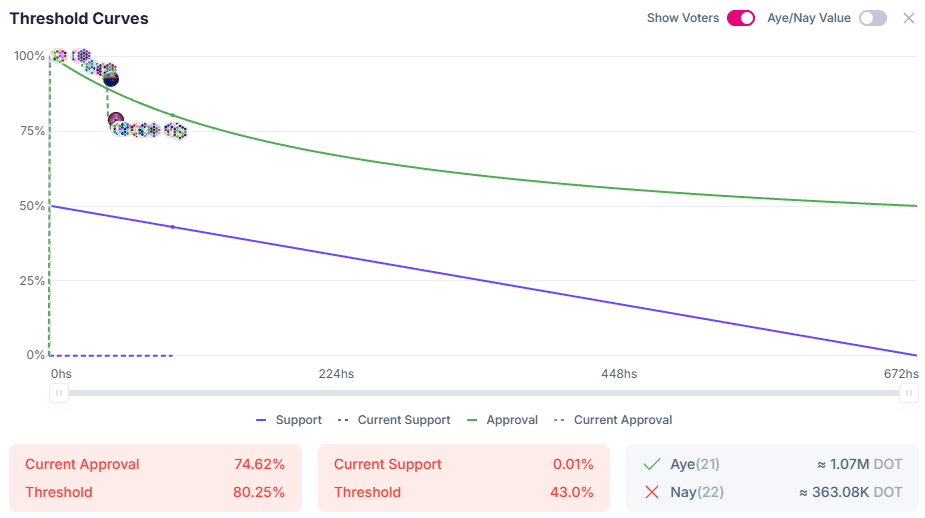
The proposal, introduced by Acala co-founder and CTO Bryan Chen, has already gathered over 75% “yes” votes at the early stage.
At the time of voting, more than 1.4 million DOT (around $5.6 million at current prices) had already been committed. The initiative aims to reduce reliance on centralized stablecoins like USDT and USDC by giving Polkadot its own decentralized, dollar-pegged asset.
The authors of the proposal stress that without a native stablecoin, Polkadot risks “losing liquidity and security.” While the idea remains controversial – the TerraUSD (UST) collapse in 2022 highlighted the risks of algorithmic models – supporters argue that the “overcollateralized” format makes the system resilient.
If approved, Polkadot would join the trend of ecosystems creating native stablecoins to strengthen their DeFi infrastructure, following the example of MakerDAO with DAI and recent initiatives from Avalanche.
Thus, the vote on pUSD could become a major step for Polkadot 2.0, strengthening its role as a DeFi hub with its own stable settlement asset.
Read also: Polkadot blockchain project overview
Polkadot 2.0 introduces a range of architectural upgrades to boost scalability and flexibility. Key innovations include Async Backing, which accelerates block processing nearly 10x; Agile Coretime, enabling blockspace rental for up to 28 days; and Elastic Scaling, which dynamically reallocates resources across projects.
Vote distribution at the time of writing. Source: polkadot.subsquare.io
According to the proposal, pUSD would operate on the Honzon protocol, which uses a collateralized debt position (CDP) model. The token would function as an overcollateralized asset, allowing users to mint pUSD against DOT collateral. The system is also expected to include a savings module that lets holders earn interest based on the stability fee.
At the time of voting, more than 1.4 million DOT (around $5.6 million at current prices) had already been committed. The initiative aims to reduce reliance on centralized stablecoins like USDT and USDC by giving Polkadot its own decentralized, dollar-pegged asset.
The authors of the proposal stress that without a native stablecoin, Polkadot risks “losing liquidity and security.” While the idea remains controversial – the TerraUSD (UST) collapse in 2022 highlighted the risks of algorithmic models – supporters argue that the “overcollateralized” format makes the system resilient.
If approved, Polkadot would join the trend of ecosystems creating native stablecoins to strengthen their DeFi infrastructure, following the example of MakerDAO with DAI and recent initiatives from Avalanche.
Thus, the vote on pUSD could become a major step for Polkadot 2.0, strengthening its role as a DeFi hub with its own stable settlement asset.
Read also: Polkadot blockchain project overview
Polkadot 2.0 introduces a range of architectural upgrades to boost scalability and flexibility. Key innovations include Async Backing, which accelerates block processing nearly 10x; Agile Coretime, enabling blockspace rental for up to 28 days; and Elastic Scaling, which dynamically reallocates resources across projects.
These changes turn Polkadot into a more adaptive platform that adjusts to developer and user needs, paving the way for ecosystem growth.



Recommended