CS2 skin market defies "Doomsday" predictions
The predicted "Doomsday" for the CS2 skin market on October 30 never materialized. Instead of a second crash after trade cooldowns expired, the market added nearly $200M, continuing its steady recovery from the initial $2B collapse.
On October 30, the total market capitalization of CS2 skins grew from $4.71 billion to $4.83 billion. Thus, the exact opposite of what analysts feared has occurred.
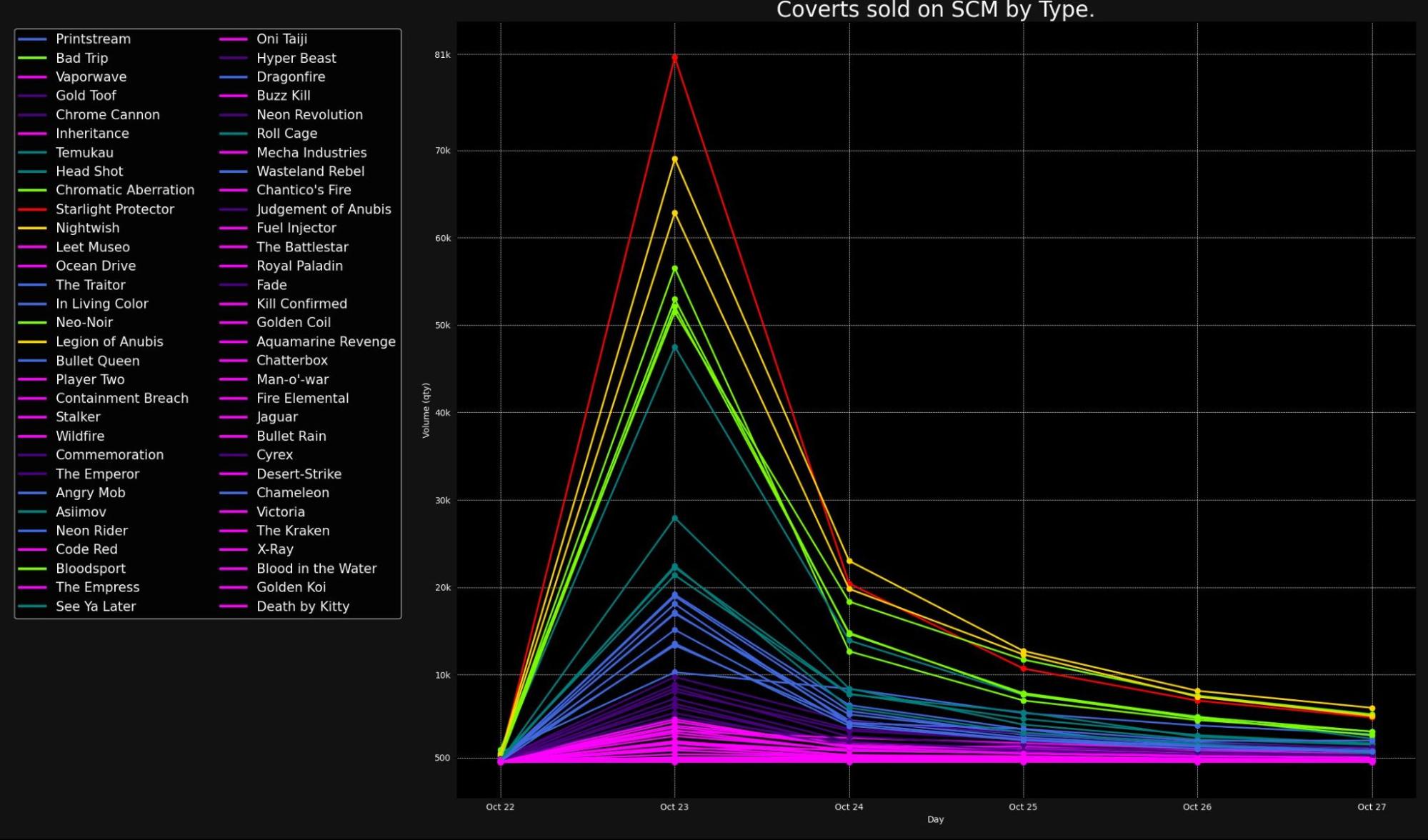
By many estimates, the expiration of the cooldowns was supposed to trigger an avalanche of selling, as traders who opened new positions after the scandalous Valve update would liquidate them to take profits.
This was exactly what the monstrous peak in sales of expensive red (Covert) skins, which occurred on October 23 during the collapse, hinted at. And it was expected that something similar would happen now.
Coverts sold on SCM by type. Source: X
Why armageddon didn't happen
Seven-day trade cooldowns exist to prevent market manipulation through rapid speculative item resales. Items uploaded to external platforms between October 23 and 25 became tradable again on October 30. This is exactly why the market was expected to be flooded with inventory from panic buyers trying to recoup their losses.
In reality, the opposite happened. Instead of collapsing under seller pressure, the market not only added approximately $200M in capitalization but showed one of the strongest single-day gains throughout the entire recovery period.
The endless flow of inventory didn't materialize (or it was absorbed by demand that exceeded supply).
Recovery trajectory
The CS2 skin economy is currently at approximately 76% of its pre-crash peak. Valve's October 23 update, which allowed knife crafting through Trade Up Contracts, crashed the market capitalization from $6.27B to a low of $3.18B in just 48 hours, shocking traders and collectors worldwide.
At this point, $1.6B of lost value has already been recovered. The market has grown from its $3.18B bottom to around $4.78B, recovering $1.6B of lost value. Traders quickly adapted to the new knife and glove prices. Prices stabilized at new supply levels, and the expiration of the waiting period eliminated uncertainty.
Why predictions were wrong
Players who moved items to external platforms during the crash likely represented long-term holders rather than panic sellers. These traders weathered the initial volatility and had no compelling reason to dump inventory after waiting periods expired. The assumption that expiring waiting periods would automatically trigger sales stemmed from a lack of sampling of who exactly was moving items during the crisis.
The market fully utilized the cooldown period to adapt to the new knife supply dynamics by October 30. Prices reflected the new post-update reality rather than panic-induced distortions. This meant there was no need for further correction after waiting periods expired. Price discovery had already been completed during the initial crash period, so no accumulated pressure remained to trigger a new drop.
Also, the recovery period attracted new buyers who viewed lower prices as an opportunity rather than a threat. This demand not only absorbed the additional supply that emerged but actually exceeded it, pushing prices upward. Doomsday scenarios didn't account for the accumulating buyer pressure during the recovery phase.
Most importantly, analysts overestimated how many items were actually locked in waiting periods and underestimated the volume of buyers in the market. Plus, seven-day locks released far fewer skins than skeptics assumed. This double miscalculation spawned predictions that diverged 180 degrees from reality.
The $200M jump
The single-day gain of $200M represents approximately 4.2% growth from the October 27 baseline. For context: this matches or exceeds daily gains during the period after the initial bounce. Markets in distribution phases rarely show accelerating growth in late-stage recovery.
The jump also confirms the hypothesis that the very fact of cooldown impact fears may have been suppressing price. Once October 30 passed without incident, the uncertainty premium evaporated, allowing prices to reflect fundamental supply and demand dynamics without a fear discount.
Valve's update: harm or benefit?
For many analysts, the potential consequences of Valve's update focused on possible catastrophic destruction of inventory value. But they all seemed to overlook stabilizing equilibrium factors.
Here's how the situation was assessed by one of the most authoritative and influential players in the world, Michael "Shroud" Grzesiek:
I think it's a W... they're trying to correct their economy because it got out of control, and they're trying to make more money by keeping it in the Steam marketplace.
Yes, high-end skin collectors lost out, but regular players gained access to items previously locked behind a wall of extreme prices. Covert skins gained value as crafting materials, creating winners alongside losers. The market redistributed rather than destroyed value, though this nuance was lost in headlines about evaporating billions.
The same thing happened with October 30 cooldown fears: everyone focused on worst-case scenarios and ignored already-operating stabilizing forces. Markets don't always follow catastrophic predictions, especially when enough time passes for participants to adjust behavior and expectations.
Remaining questions
Aggregated capitalization doesn't reveal whether specific knives or Covert skins experienced volatility that was neutralized in overall figures. Prices on individual item categories could have moved sharply while the overall market remained stable or grew. Understanding performance at the category level would clarify whether recovery is broad-based or concentrated.
Trading volume provides important context: high volume indicates broad user participation, while low volume points to thin markets and potential temporary price imbalances.
Regional market variations should also be considered. Asian, European, and North American markets may have experienced different dynamics during the cooldown period.
Finally, the relationship between different item tiers needs assessment. Have high-end knives recovered proportionally to mid-tier items? Are Covert skins maintaining elevated prices or normalizing? Category-specific analysis would reveal which segments are driving overall market performance.