Colorado court finds pastor guilty of $3M crypto scam

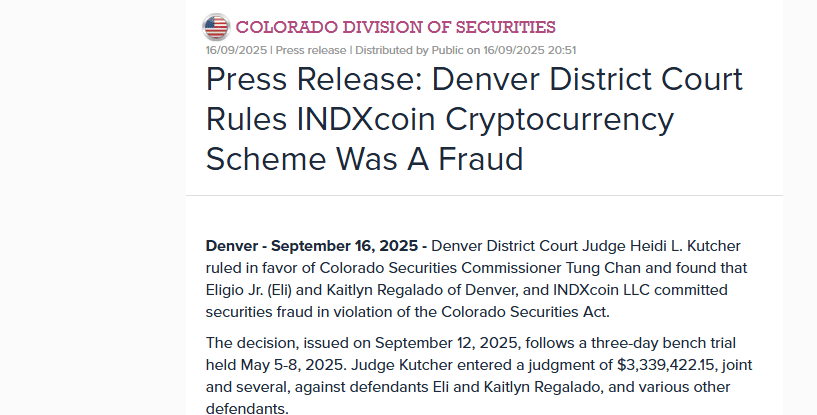
The Denver District Court ruled against Pastor Eli Regalado and his wife Kaitlyn, finding them guilty of fraud tied to cryptocurrencies INDXcoin and Sumcoin.
The couple promoted INDXcoin as a “divine project” but used the money for personal expenses. Judge Heidi Kutcher determined the couple violated Colorado securities laws and ordered them to return $3.39 million to investors.
Investigators found that at least $1.3M of the raised funds went to personal expenses, including luxury handbags, jewelry, cars, vacations and home renovations. Some money was funneled into their church, Victorious Grace.
The case stands as one of the largest examples of crypto fraud in U.S. religious circles in recent years, showing how trust within a community can be exploited to deceive investors.
Screenshot of press release. Source: publicnow.com
According to case materials, the couple raised funds from more than 509 INDXcoin investors and 87 Sumcoin investors, mostly from their church community. Marketing materials claimed the token’s creation was “inspired by God,” and decisions were guided by a so-called “Prophetic Team” that held up to five calls a week.
INDXcoin was marketed as “safer than other cryptocurrencies” and a guaranteed profitable asset. In reality, it was never listed on regulated exchanges and proved illiquid. The court ruling stated plainly: “INDXcoin was worthless because nobody wanted to buy it.”
Investigators found that at least $1.3M of the raised funds went to personal expenses, including luxury handbags, jewelry, cars, vacations and home renovations. Some money was funneled into their church, Victorious Grace.
Beyond the civil ruling, in July 2025 the Regalados were indicted by a grand jury on 40 criminal counts, including securities fraud, theft and racketeering. They face potential prison time in the criminal case, while the civil court also banned them from engaging in investment activities for the next 20 years.
The case stands as one of the largest examples of crypto fraud in U.S. religious circles in recent years, showing how trust within a community can be exploited to deceive investors.