AI investment wave lifts British pound and Sweden’s krona

Europe’s currencies are starting to feel the knock‑on effects of the AI build‑out. The clearest beneficiaries so far, traders say, are Sweden’s krona and the British pound.
The logic is straightforward: the more money flows into new data centres and AI projects, the greater the demand for the local currency. This channel is not the only driver, but market analysts watch it closely because investment tends to feed into jobs and consumer spending – both important for exchange rates.
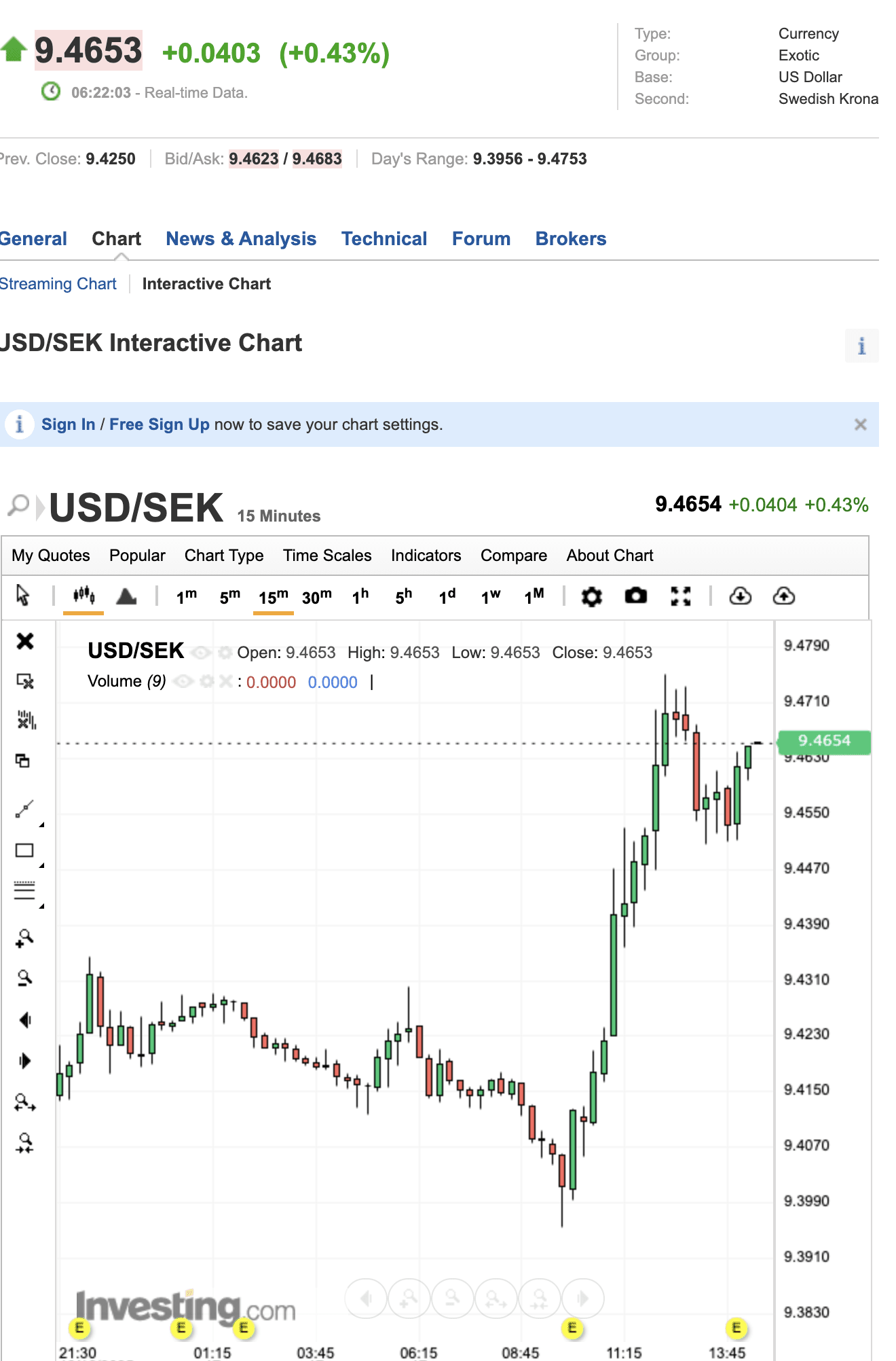
In 2025, the krona has been among Europe’s top performers against a softer US dollar, gaining almost 15%, while the pound is up roughly 7%. Pinning down the “AI share” of these moves is tricky: FX also swings with interest‑rate expectations, global demand for the dollar, and fiscal concerns, the latter being a recurring theme in the UK.
Change in the USD/SEK exchange rate. Source: Investing
Sweden and the UK sit in the global top five for private AI investment. By some estimates, each attracted just over $4 billion (about €3.7 billion/£3.3 billion) in 2024.
In Sweden, global players (Microsoft, Meta, Alphabet and Brookfield) are building data‑center capacity, leaning on abundant renewable power and robust grid infrastructure. Much of the activity is in the north, where cheap hydropower and a cooler climate lower cooling costs. New sites are paired with long‑term green power contracts and an expansion of backbone fiber‑optic networks.
The world’s leading AI chipmaker, Nvidia, is offering Swedish firms (from Ericsson to AstraZeneca) access to high‑performance GPU clusters and software stacks for training and inference.
In the UK, sentiment has been boosted by a recent tech pact with the United States and headline promises of £31 billion in investment that span semiconductors, AI safety and cloud. New entities benefit from tax incentives and a faster permitting path for data‑center projects.
Market size matters too. Sterling is the world’s fourth‑most traded currency with a little over 10% of global turnover; the krona’s share is under 2%. That means AI‑related inflows show up more visibly in Swedish assets, while in sterling they can be diluted by the market’s depth.
The big question ahead is productivity. If AI lifts output per worker, both the pound and the krona could gain a more durable tailwind. For now, the growth and jobs impact still needs to prove itself in hard data.